
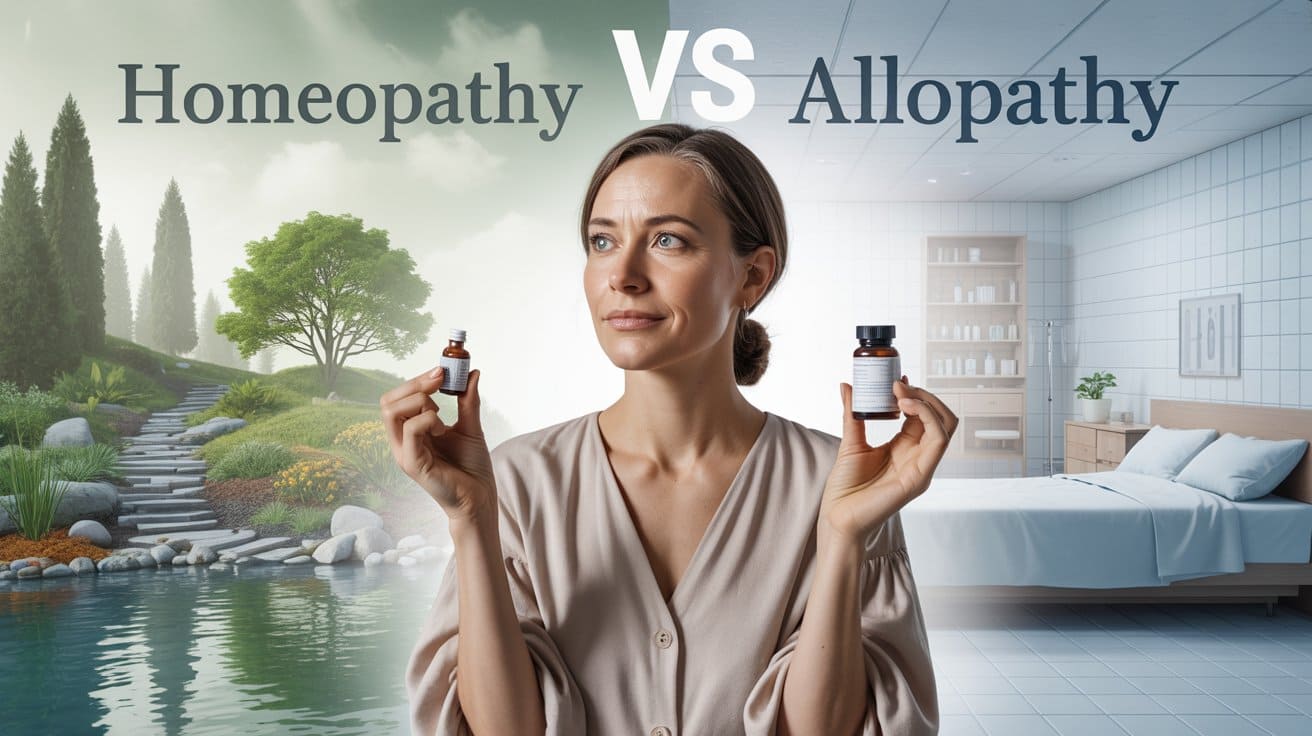
Today’s health and wellness landscape offers people a broad spectrum of treatment options. Surely among the most commonly discussed are homoeopathy and allopathy, two distinct forms of medicine that are different in philosophy, approach, and delivery of treatment. For good healthcare decisions that align with your beliefs and needs, it is important to understand the homoeopathy vs allopathy differences.
This article will take a look at the homoeopathy vs allopathy discourse, not to profess one right way, but to add understanding of the different aspects, attributes, benefits, and limitations of each. Whether you are challenged with chronic illnesses or looking for some treatment for regular, everyday ailments, understanding the differences between homoeopathy and allopathy can help develop a path to healing.
Also Read: Benefits of Homoeopathy
Understanding the Basics
Allopathy, which is also referred to as conventional medicine or modern medicine, is the system of medicine most people are familiar with. It is the dominant paradigm of medicine that depends on medications, surgery and other techniques proven to be effective through scientific means to treat disease. Doctors who are trained in allopathy will focus on diagnosing, treating and typically suppressing, if not eliminating, the symptoms of disease.
Homoeopathy is a form of alternative medicine formally developed in the late 18th century by the German physician Samuel Hahnemann. It works on the principle of “like cures like” – that is, a substance that can cause symptoms in a healthy person, when diluted and taken in very small doses, will cure similar symptoms in a sick person.
Homoeopathy vs. Allopathy: The Core Philosophies
The main difference between homoeopathy and allopathy is the way they treat a disease or health issue.
- Allopathy talks about the disease directly. For instance, in the case of infection, we give antibiotics to kill the or kill the bacterium directly. We concentrate on the organism or the faulty organ/system.
- Homoeopathy regards symptoms as being the body’s attempt to heal itself. The treatment is individualised, so while the two people presenting the same condition will receive a different remedy, as they will have had a different physical, emotional and mental state.
It is this contrast in mode of practice that fuels much of the homoeopathy versus allopathy dialogue. Allopathy wants to fix it now, whereas homoeopathy is about fixing the individual in a mindful, long-term balance and wellness.
Ingredients and Treatment Methods
When comparing homoeopathy and allopathy, one of the distinguishing factors is how each is comprised or formulated.
- The medications are chemically or artificially based. They can be effective and very quickly, but there is also the possibility of side effects or some form of dependency if they are a long-term.
- Homoeopathy is based on natural sources, plants, minerals, and sometimes even by-products of animals, but importantly, they are very diluted. It is thought that the level of dilution enhances the healing properties of the remedies and diminishes side effects.
This again demonstrates a key aspect of homoeopathy versus allopathy; potency versus subtlety. Allopathy attacks symptoms, but homoeopathy encourages healing from the body.
Evidence and Acceptance
A further distinction that may exist between homoeopathy and allopathy stems from scientific evidence and acceptance around the world; Allopathy is accepted throughout the world, and in virtually every country, there is rigorous scientific research, standardised regulation, and clinical trials supporting the practice of Allopathy. Allopathy is largely evidence-based, standardised, and is a preferred and accepted option where emergencies and serious illness exist, such as a heart attack or cancer.
Although aesthetically pleasing across countries like India and several parts of Europe, homoeopathy is not without its critics. Corps of detractors and Be slippers have a reputation amongst sectors of the scientific community for not providing or presenting some of the same types of strong scientific evidence to support treatment. Some clearly show favourable outcomes, while several in the scientific community will simply out these outcomes to the so-called placebo effect.
Nevertheless, the debate between the practice of homoeopathy and allopathy continues, however, and millions of patients have and continue to state favourable long-term positive responses with homoeopathic treatment, especially allergies, chronic pain, and skin issues
Treatment Time and Cost
A final aspect to contrast between homoeopathy and allopathy is their speed of effect and costs, and time associated –
- Allopathy is quicker in effect, making it ideal for acute conditions, while the downside of allopathy is long-term treatment, which can either be expensive or unsafe because of the side effects or risk of surgery.
- Homoeopathy is slower in its visible effect; however, homoeopathy is more affordable and safer generally, for longer-term treatment of chronic conditions.
Patient-Centred vs. Disease-Centred
Another aspect to consider of homoeopathy versus allopathy is the individualised treatment.
- In allopathy, treatment is disease-centred. Each individual will still get the same treatment for the same condition, regardless of the temperament or background of each patient.
- In homoeopathy, treatment is highly individualised. Homoeopaths treat each patient according to their emotional, mental, and physical state, and provide remedies according to their constitution.
The level of individualised care is one reason why some people feel homoeopathy, in some way, “understands” them better; this brings an emotional component to the distinction between homoeopathy and allopathy.
Also Read: Homoeopathy vs Ayurveda
Conclusion
Deciding between homoeopathy vs. allopathy shouldn’t be seen as an “either/or” scenario or a competition to see which is better. Rather, it should be viewed as understanding what each system can offer you and how it aligns with your health goals. The distinctions between homoeopathy and allopathy are very distinct. While one is a fast-acting, evidence-based, disease-centred approach, the other appeals to more gentle modalities, more holistic and individualised approaches, and restoring holistic balance to a person, not just “the disease.”
It is clear what to do in an emergency or life-threatening situation. Allopathy is the obvious first choice. Allopathic medicine will save your life, and do so quickly. For chronic issues, minor illnesses, or when wanting a more naturally-oriented, side-effect-free approach to a health issue, homoeopathy could be your first-line treatment or an effective companion to an allopathic approach.
If you are considering a shift or an integration, the best choice is to seek out qualified practitioners in both systems to ensure your treatment plan is safe, beneficial, and effective.

Related Posts

Understanding Natural Treatment for PCOS & Symptoms

Homoeopathy vs Ayurveda: Understanding the Key Differences
What is Homoeopathy and How Does Homoeopathy Work?

One Comment